

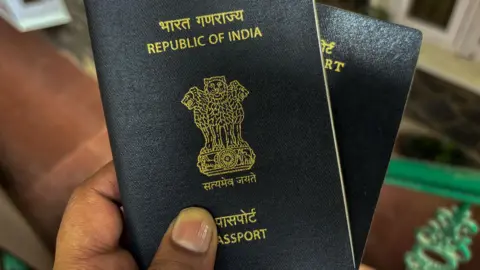
In recent months, a video from an Indian travel influencer complaining about India's weak passport went viral on social media.
He mentioned that while nearby nations like Sri Lanka and Bhutan were more welcoming to travelers from India, securing travel permits to travel to many nations in Europe and the West continued to be difficult.
Such concerns regarding the limited global access of Indian passports was reflected in recent Henley Passport Index, ranking India at position eighty-five among nearly two hundred nations, five spots lower than last year.
The Indian government has not commented on the report yet.
Nations like Ghana, Rwanda and Azerbaijan with much smaller economies than India – a nation that is the world's fifth biggest economy – hold better positions in the ranking at the 78th, 74th and 72nd spots, respectively.
In fact, the country's position over the last ten years has remained around the eighties, even dipping to ninetieth place in 2021. Such standings appear poor when measured against other Asian countries such as Japan, South Korea and Singapore, which have consistently held top positions.
What Passport Strength Measures
Passport strength reflects a nation's soft power and global influence. This leads to better mobility for passport holders, improving commercial and learning opportunities. A weak passport means more paperwork, higher visa costs, fewer travel privileges and extended processing periods when journeying.
However, even with the decline in the rank, the number of countries providing visa-free travel to Indians has grown over the last ten years.
For example, eight years ago – the year the current administration's Bharatiya Janata Party (BJP) assumed office – 52 countries offered visa-free travel for Indian passport holders with the passport at seventy-sixth position in the ranking.
The following year, it fell to eighty-fifth place, then improved to 80th in 2023 and 2024, dropping again to the 85th position currently. At the same time, countries allowing visa-free travel to Indian citizens grew from 52 in 2015 to 60 in 2023 and 62 in 2024.
Increasing Worldwide Travel Competition
The count of visa-free destinations this year (fifty-seven) is higher than the number eight years ago (52), yet India's rank during both periods is 85. What explains this situation?
Experts say that a primary factor involves growing competition in global mobility – meaning countries are entering into more travel partnerships to benefit their citizens and economic growth. According to a 2025 report, the global average count of countries travellers are able to access visa-free has nearly doubled from 58 in 2006 to 109 in 2025.
As an illustration, China has increased the number of visa-free countries its citizens can travel to from fifty to eighty-two in the past decade. As a result, its position on the index has enhanced from 94th to 60th during the same time period.
In comparison, The Indian passport – previously positioned 77th on the index during summer – dropped to the 85th position this autumn following the loss to two countries.
Other Influences Affecting Passport Strength
An ex-diplomat from India says multiple elements influencing the strength of a country's passport, like economic and political conditions as well as its receptiveness to welcoming citizens from other countries.
For instance, the American passport has fallen from the top ten currently holding the 12th position – its lowest ever – because of its increasingly insular stance in world politics.
The former ambassador mentioned how in the 1970s, Indians enjoyed visa-free access to many Western and European countries, though this shifted after the Khalistan movement during the eighties. Later political disturbances have further chipped away at India's image as a stable democracy.
"Many countries are also becoming increasingly wary regarding migrants," the diplomat added. "The country possesses a large quantity of people migrating to other countries or overstaying their visas and that interferes with the national image."
Factors like the security level a country's passport is and immigration processes also play a role in gaining visa-free access to foreign nations.
Enhanced Security Measures
The Indian passport faces ongoing security threats. In 2024, law enforcement detained over two hundred individuals for alleged visa and passport fraud. The country also has complex immigration processes and a slow pace for visa approvals.
The diplomat says that new technologies, such as the newly introduced electronic passport or e-passport, can improve security and ease the immigration process. The e-passport includes a small chip that stores biometric information, increasing difficulty to forge or tamper with the passport.
However, increased diplomatic efforts and travel agreements remain key to boosting international travel freedom for Indian citizens and, by extension, the Indian passport's global position.


